Spousal Buyouts: What You Need to Know When Keeping the Family Home
Separation and divorce can come with a lot of difficult decisions, and one of the biggest questions is often, “What happens to the family home?”
Selling the home and dividing the equity may be the right solution for some couples, but it isn’t the only option. In some situations, one spouse may be able to keep the home by buying out the other spouse’s share of the property.
This is often referred to as a spousal buyout.
If you are considering keeping the family home, understanding how a spousal buyout works and what you may qualify for can help you make more informed decisions as you work through your separation.
What Is a Spousal Buyout?
A spousal buyout is when one spouse takes ownership of the home and pays the other spouse for their share of the equity following a separation or divorce.
Typically, new mortgage financing is arranged to help:
Pay out the existing mortgage
Pay the departing spouse their agreed-upon share of the equity
In some circumstances, consolidate eligible joint debts outlined in the separation agreement
One important thing to know is that a qualifying spousal buyout can be treated differently from a traditional refinance. Depending on the circumstances, this may provide access to more financing than you would typically have through a standard refinance.
Spousal Buyout vs. Traditional Refinance
With a traditional refinance, homeowners are generally limited to borrowing up to 80% of the appraised value of the property.
A qualifying spousal buyout may be treated as a purchase transaction by some lenders and mortgage insurers. This can potentially allow for insured financing above the traditional 80% refinance limit, subject to the applicable guidelines and qualification requirements.
Here’s a simple example:
Let’s say the family home is valued at $600,000
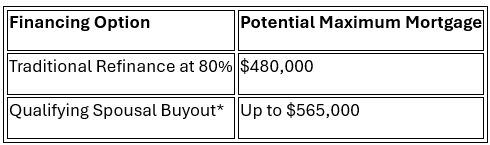
*Before applicable mortgage insurance premiums and subject to qualification and insurer guidelines.
In this example, there could potentially be an additional $85,000 of financing available compared with a traditional refinance. That additional financing could help with the amount required to buy out the departing spouse and, where permitted, address other eligible obligations included in the separation agreement.
It is important to remember that these numbers are an example only. The amount available will depend on the property's appraised value, existing mortgage balance, agreed-upon buyout amount, income, debts, lender and insurer guidelines, and the overall details of the separation.
Can You Qualify for a Spousal Buyout?
Just like any other mortgage application, the spouse keeping the home will need to qualify for the new mortgage.
Lenders will typically look at things such as:
Income and employment
Credit history
Existing debts and financial obligations
Mortgage stress test requirements
The value of the property
The amount required for the buyout
If you receive child support or spousal support, it may be possible to use that income to help qualify for the mortgage when it is properly documented and expected to continue.
On the other hand, support payments you are required to make will generally need to be included in your debt obligations and can affect how much you qualify for.
Every lender has its own policies and documentation requirements, so this is one area where it is helpful to have your situation reviewed early.
What Documents Will You Need?
There can be some differences depending on the lender and the circumstances, but you will generally need documentation that clearly outlines the financial arrangements between both spouses.
This may include:
A signed separation agreement
Details confirming the agreed-upon buyout amount
An appraisal of the property
Documentation relating to the existing mortgage
Legal documentation transferring ownership of the property
The separation agreement is particularly important because it gives the lender a clear picture of how the property, debts, equity and support obligations are being divided.
It can also be important if either spouse plans to purchase another property in the future, as the financial obligations outlined in the agreement may need to be considered for their next mortgage application.
Don't Forget About the Other Costs
The mortgage itself isn't the only cost to consider when completing a spousal buyout.
Depending on your situation, there may also be:
Mortgage insurance premiums, where applicable
Legal fees
Appraisal fees
Land title or property registration fees
Penalties for breaking an existing mortgage
Other costs associated with transferring ownership
Understanding these costs upfront can help you determine whether keeping the home is financially realistic and sustainable.
Start the Conversation Early
If you are separating or are in the process of negotiating a separation agreement, don't wait until everything is finalized before looking at your mortgage options.
This is one of those situations where planning ahead can make a big difference.
Before agreeing to a buyout amount or making decisions about the family home, it can be helpful to have a mortgage professional review your income, debts, existing mortgage, property value and the proposed buyout.
I can help you look at the numbers and understand what may be possible based on your individual circumstances.
Thinking About Keeping the Family Home?
A spousal buyout can be a possible option for homeowners who want to remain in their family home, but it is not the right solution for everyone.
The earlier you understand your mortgage options, the better prepared you can be when making decisions about the home and your next chapter.
If you are going through a separation and want to understand whether keeping the family home may be possible, I’m happy to have a confidential conversation and walk through your options with you.
Mortgage qualification and financing options are subject to lender and insurer guidelines and individual circumstances. The examples above are for illustration purposes only and are not a guarantee of mortgage approval or available financing.